


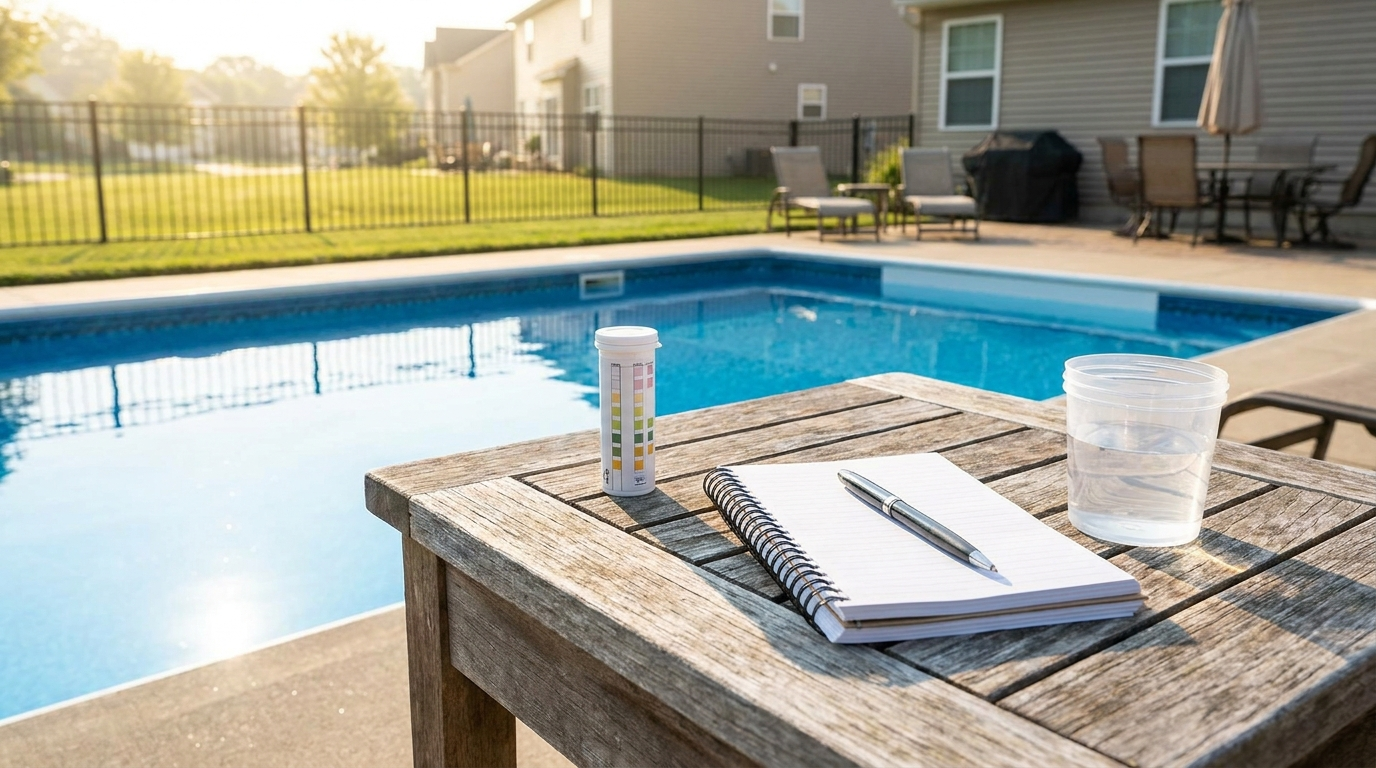
Pool testing can feel confusing at first. A test strip or kit may show several numbers at once, and each one seems important.
The good news is that pool care becomes easier when you know what each reading is trying to tell you. You do not need to memorize every detail. You only need a clear order of action.
A smart testing routine helps you avoid guessing. It also helps prevent overcorrection, which is one of the most common reasons pool water becomes harder to manage.
This guide explains how to read pool test results in a practical way.
Start with pH
pH is one of the most important readings because it affects comfort, clarity, and sanitizer performance.
If pH is too low, the water may feel sharp or irritating. It can also become corrosive to metal parts and some surfaces.
If pH is too high, the water may look cloudy. Scale can form more easily, and sanitizer may not work as well.
When pH is out of range, many other pool problems become harder to solve. That is why pH should be checked often.
Check Total Alkalinity Next
Total alkalinity helps pH stay steady. If pH changes often, alkalinity may be part of the reason.
Low alkalinity can allow pH to swing up and down. High alkalinity can make pH difficult to adjust downward.
This reading is especially useful when you feel like you are correcting pH again and again. It helps explain why the water is not holding balance.
For a broader view of how these levels work together, the iGarden pool chemistry resource can help connect test results with routine maintenance choices.
Review Sanitizer Level
Sanitizers help control contaminants from swimmers, debris, and the environment.
If the sanitizer is too low, algae and bacteria can grow more easily. The water may also smell unpleasant or become cloudy.
If sanitizer demand is high, look at recent conditions. Heavy swimming, high heat, rain, and debris can all reduce available sanitizer.
Sanitizer does not work alone. It performs best when pH is in a proper range and circulation is strong.
Look at Water Clarity
Your eyes are not a replacement for testing, but they still matter.
Clear water usually means the system is moving in the right direction. Dull or hazy water means something needs attention.
Cloudiness can come from high pH, low sanitizer, low filtration, fine debris, or algae. It can also come from several issues at once.
When water clarity changes, test before adding anything.
Think About Recent Events
Test results make more sense when you connect them to what happened recently.
Rain may dilute chemicals and add debris. Hot weather may increase sanitizer demand. A large swim day may change pH and sanitizer levels.
Adding refill water can also change balance, especially if the source water has different mineral content or alkalinity.
This context helps you avoid treating the wrong problem.
Use a Simple Order of Action
A clear order makes testing less stressful.
First, remove debris and check circulation. Poor flow can make every chemical issue harder.
Second, test pH, alkalinity, and sanitizer.
Third, make one adjustment at a time. Do not add several chemicals at once unless the situation clearly requires it.
Fourth, let the pump run and retest later.
Why One Test Is Not Always Enough
One test gives you a snapshot. A pattern gives you a better answer.
If pH is low once, you may need a small correction. If pH drops every week, you should look deeper.
If sanitizer is low after a party, that may be normal. If it is low every morning, the pool may have a larger demand problem.
Keeping simple records can reveal these patterns.
Common Reading Combinations
Low alkalinity and changing pH often point to unstable water.
High pH and cloudy water may suggest scale risk or reduced sanitizer efficiency.
Low sanitizer and green tint may suggest algae growth.
Normal readings with cloudy water may point to filtration, circulation, or fine debris.
Repeated low sanitizer after hot days may mean sunlight and use are increasing demand.
These combinations help you think beyond one number.
Avoid These Testing Mistakes
Do not use expired test strips.
Do not test immediately after adding chemicals.
Do not collect water only from the surface near a return jet.
Do not make large corrections based on one uncertain reading.
Do not ignore the filter when chemistry looks normal but water stays cloudy.
Good testing is not only about the kit. It is also about timing and interpretation.
Final Thoughts
Pool test results are easier to understand when you read them in context. pH, alkalinity, sanitizer, clarity, and recent use all work together.
You do not need a complicated routine. You need a consistent one.
Test regularly, adjust slowly, and watch for patterns. This approach keeps pool care practical and helps prevent small problems from becoming expensive ones.
