


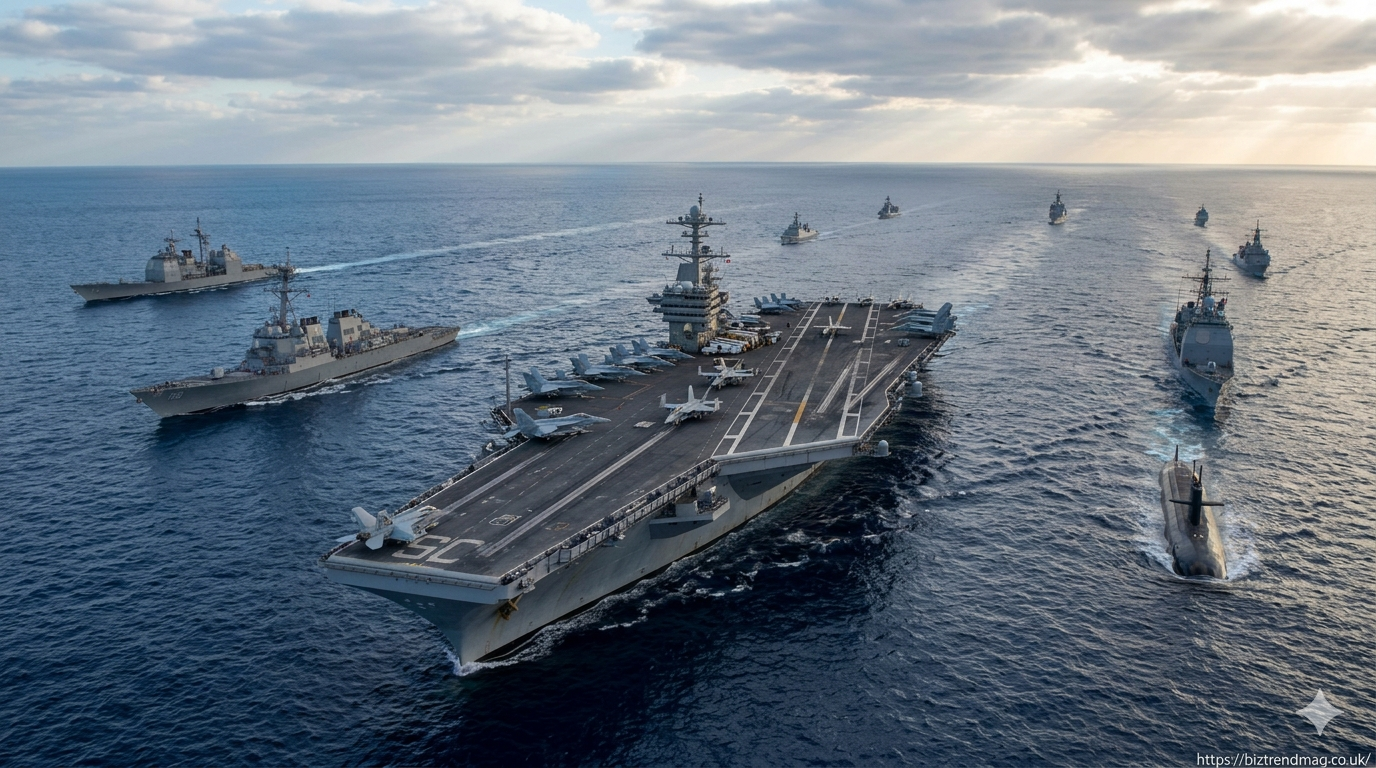
Are you wondering how global maritime security remains intact during rising international tensions? The United States Navy faces unprecedented challenges as sea lanes become contested combat zones. Failing to scale fleet capacity rapidly could jeopardize international trade routes and compromise national defense boundaries. By exploring the latest 2026 fleet data, you will discover how strategic ship building investments, advanced autonomous vessels, and carrier strike groups ensure total maritime dominance.
What Is the Current Strategy of the United States Navy?
The United States Navy operates as the premier global maritime force, executing continuous forward deployments to protect international waters. According to the official Department of the Navy records, the service is currently undergoing a massive strategic transformation under the newly released 2026 Shipbuilding Plan. This generational initiative shifts the maritime force from a peacetime posture to an active warfighting enterprise focused on peer-level deterrence.
The main objective of this modern doctrine is maintaining undisputed sea control. By integrating conventional strike power with cutting-edge digital infrastructure, the fleet projects absolute authority across critical oceanic chokepoints.
                           [U.S. Navy Global Command Structure]
                                            │
               ┌────────────────────────────┼────────────────────────────┐
               ▼                            ▼                            ▼
   [Carrier Strike Groups]      [Surface Action Groups]     [Submarine Force]
               │                            │                            │
   ┌───────────┴───────────┐    ┌───────────┴───────────┐    ┌───────────┴───────────┐
   ▼                       ▼    ▼                       ▼    ▼                       ▼
Supercarriers      Air Wings  Destroyers    Frigates & LCS  Attack (SSN)   Ballistic (SSBN)
How Large Is the Active Navy Fleet Fleet Capacity?
The active Navy inventory contains approximately 290 deployable combat vessels, anchoring a total ready force of over 460 ships. To counter evolving anti-access and area-denial threats in the Indo-Pacific, the Department of the Navy formally unveiled a historic 450-ship expansion plan. This strategic blueprint integrates autonomous systems into long-term force calculations for the first time in history.
The future fleet composition establishes a highly distributed combat ecosystem. It balances high-end capital ships with versatile, lower-cost surface combatants to expand sensor networks and missile launch capacity over massive geographic areas.
| Ship Category | Current Active Count (2026) | Projected Target (2031 Plan) | Primary Strategic Function |
| Aircraft Carriers | 11 Deployed | 12 Operational | Global Power Projection & Airborne Strike |
| Battle Force Warships | 220 Active | 299 Deployed | Surface Warfare, Fleet Defense, & Land Strike |
| Auxiliary & Logistics | 59 Support | 68 Enhanced | Fleet Replenishment & Expeditionary Logistics |
| Unmanned Maritime Systems | 5 Testing | 83 Fully Integrated | Autonomous Reconnaissance & Distributed Payload |
| Total Naval Vessel Force | ~290 Deployable | 450 Total Vessels | Global Maritime Dominance & Deterrence |
Why Are Aircraft Carriers the Core of Naval Power Projection?
Supercarriers remain the ultimate symbol of American military might on the high seas. The Navy maintains 11 active nuclear-powered aircraft carriers, transitioning from the legacy Nimitz-class to the technological marvels of the Gerald R. Ford-class. These massive warships function as floating, sovereign American airbases capable of launching devastating strikes anywhere on earth.
- Gerald R. Ford-Class Power: Features the Electromagnetic Aircraft Launch System (EMALS), replacing old steam catapults to launch aircraft faster.
- Massive Air Wings: Carries up to 90 aircraft, including fifth-generation F-35C Lightning II stealth fighters and EA-18G Growler electronic attack jets.
- Sortie Generation: Capable of executing 160 routine daily sorties, surging up to 270 during high-intensity conflict scenarios.
What Role Do Submarines Play in Secret Underwater Warfare?
Beneath the ocean waves, the Navy Submarine Force commands total undersea dominance. Operating silently to gather intelligence and conduct maritime denial missions, these nuclear-powered vessels are virtually undetectable. The fleet utilizes a highly specialized mix of attack submarines and strategic ballistic missile platforms.
                        [U.S. Undersea Warfare Force Structure]
                                           │
                    ┌──────────────────────┴──────────────────────┐
                    ▼                                             ▼
         [Fast Attack Submarines]                     [Ballistic Missile Subs]
          (Virginia & Seawolf Class)                        (Ohio Class)
                    │                                             │
         ┌──────────┴──────────┐                          ┌───────┴───────┐
         ▼                     ▼                          ▼               ▼
Intelligence Gathering   Precision Strike             Nuclear Deterrence  Surfaced Launch
The elite Virginia-class fast-attack submarines play a decisive role in heavily defended coastal zones. Equipped with large payload modules, they launch Tomahawk cruise missiles and deploy special operations forces without alerting adversary radar networks.
How Do Guided Missile Destroyers Protect Fleet Assets?
Arleigh Burke-class guided-missile destroyers serve as the workhorse of the surface Navy. These multi-role combatants protect carrier strike groups from synchronized missile saturation attacks. The latest Flight III iteration introduces the advanced AN/SPY-6 Air and Missile Defense Radar, which tracks ballistic missiles and stealth aircraft simultaneously.
With over 90 Vertical Launch System (VLS) cells per ship, destroyers carry a devastating arsenal of anti-air, anti-submarine, and land-attack weapons. They secure contested waters so that logistics vessels can move freely.
What Is the Future of Unmanned Autonomous Warships?
The integration of autonomous technology marks the most significant conceptual shift in modern Navy history. Recognizing that building traditional manned warships takes years, the service is embracing medium and large unmanned surface vessels (USVs). These robotic ships act as force multipliers across the Pacific Ocean.
By operating without a human crew, autonomous vessels undertake high-risk scouting missions. They transmit targeting data back to the main battle force, keeping human sailors safely out of enemy missile range.
How Does the Navy Secure Global Maritime Trade Routes?
The global economy relies entirely on open sea lanes, with over 80% of international trade moving by water. The Navy secures these vital maritime highways by conducting regular freedom of navigation operations (FONOPs) in contested straits. These deployments deter piracy, prevent illegal blockades, and guarantee that merchant shipping remains uninterrupted.
Through constant global vigilance, the maritime force protects crucial economic corridors like the Strait of Hormuz and the Malacca Strait. This presence prevents rogue actors from weaponizing shipping choke-points.
What Are the Latest Shipbuilding Upgrades in 2026?
The Department of the Navy released its Fiscal Year 2027 Shipbuilding Plan in mid-May 2026, outlining aggressive steps to revitalize the domestic maritime industrial base. A primary focus is accelerating the production of Constellation-class guided-missile frigates. These agile warships offer affordable anti-submarine warfare capabilities and convoy protection.
                        [2026 Shipbuilding Strategic Focus Areas]
                                            │
               ┌────────────────────────────┼────────────────────────────┐
               ▼                            ▼                            ▼
   [Constellation Frigates]         [Modular Integration]         [Shipyard Automation]
  Affordable convoy escort and     Fragmented parts production   AI-driven assembly tools to
   anti-submarine operations.      shipped to central assembly.   eliminate manual backlogs.
To deliver these platforms quickly, the service is implementing modular manufacturing processes. Shipyards assemble massive prefabricated sections simultaneously, cutting total construction timelines by months.
How Does Joint Force Integration Enhance Combat Lethality?
No military branch wins modern conflicts alone, prompting the Navy to master All-Domain Operations. Through secure satellite networks, naval assets link directly with U.S. Air Force bombers, Army missile batteries, and Space Force tracking systems. This interconnected network shares real-time targeting telemetry instantaneously.
If a satellite spots an adversarial threat, a surfaced destroyer can launch standard missiles using that remote data. This collaborative warfare style ensures the military strikes with unified precision.
Why Is Enhancing E-E-A-T Critical for Naval Operations?
The Department of the Navy prioritizes Experience, Expertise, Authoritativeness, and Trustworthiness (E-E-A-T) across all operational sectors. To ensure absolute data accuracy and command integrity, leadership recently appointed three new Portfolio Acquisition Executives. These specialized leaders manage aviation, mission systems, and munitions portfolios directly.
By streamlining command structures under verified experts, the service eliminates bureaucratic inefficiencies. This administrative reform directly boosts fleet readiness and ensures that technical innovations transition to the front lines without delay.
Frequently Asked Questions About Naval Strategy
How many aircraft carriers does the US Navy currently operate?
The service operates 11 active nuclear-powered supercarriers globally. This fleet includes ten battle-proven Nimitz-class carriers and the ultra-modern USS Gerald R. Ford (CVN-78), with additional Ford-class platforms currently undergoing advanced pre-commissioning trials.
What is the purpose of the 450-ship expansion plan?
The 450-ship initiative expands maritime combat mass to counter rising near-peer naval capabilities. The strategy integrates 299 manned battle force warships with 83 autonomous unmanned maritime systems to distribute sensor and missile capacity widely.
Which submarine class forms the backbone of undersea attack operations?
The Virginia-class fast-attack submarine serves as the premier platform for undersea strike and reconnaissance. These nuclear-powered vessels carry advanced payload modules for Tomahawk cruise missiles and operate silently inside highly contested anti-access zones.
What are Constellation-class frigates designed to do?
Constellation-class frigates provide highly cost-effective multi-role combat capabilities. They specialize in anti-submarine warfare, local fleet defense, convoy protection, and distributed maritime operations, freeing up larger destroyers for high-end strike missions.
How does the service utilize autonomous maritime vessels?
Autonomous vessels act as unmanned scout platforms and remote missile magazines. They operate ahead of the main strike group to detect enemy positions, tracking threats without exposing human crews to initial waves of hostile counter-fires.
Where is the homeport for the newly commissioned USS Cleveland?
The USS Cleveland (LCS 31), commissioned on May 16, 2026, as the sixteenth and final Freedom-variant littoral combat ship, will operate out of Naval Station Mayport, Florida, to support agile near-shore defense operations.
Conclusion
The landscape of global maritime defense is shifting rapidly as technological innovations rewrite the rules of naval engagement. Staying informed on these critical defense updates helps citizens and policy analysts understand how global stability is maintained. Explore the official U.S. Navy Press Office for real-time announcements, review the detailed MyNavyHR Portal for personnel strategies, or analyze detailed deployment breakdowns on the Naval News network. Share this comprehensive analysis on social media to spark meaningful discussions regarding the future of international maritime security!
