


In today’s world, numbers are more than just mathematical symbols; they carry meanings, represent systems, and serve as identifiers across multiple domains. One number sequence that has drawn attention in both educational and practical contexts is 9632×97. At first glance, this sequence may appear as a simple arithmetic expression, but it has applications in mathematics, technology, data analysis, and beyond. This article delves deeply into 9632×97, its interpretation, practical uses, and significance in modern applications.
Understanding the Basics of 9632×97
The sequence 9632×97 can be interpreted in various ways depending on the context. Typically, the “x” symbolizes multiplication, making it an arithmetic operation involving two numbers: 9632 and 97. Multiplication of large numbers is a fundamental concept in mathematics, forming the basis for more complex calculations in science, finance, and engineering.
From a pure mathematical perspective:
- Step 1: Recognize the numbers: 9632 and 97
- Step 2: Identify the operation: multiplication
- Step 3: Compute the product
Breaking it down further, multiplying 9632 by 97 gives:
- Multiply 9632 × 90 = 866,880
- Multiply 9632 × 7 = 67,424
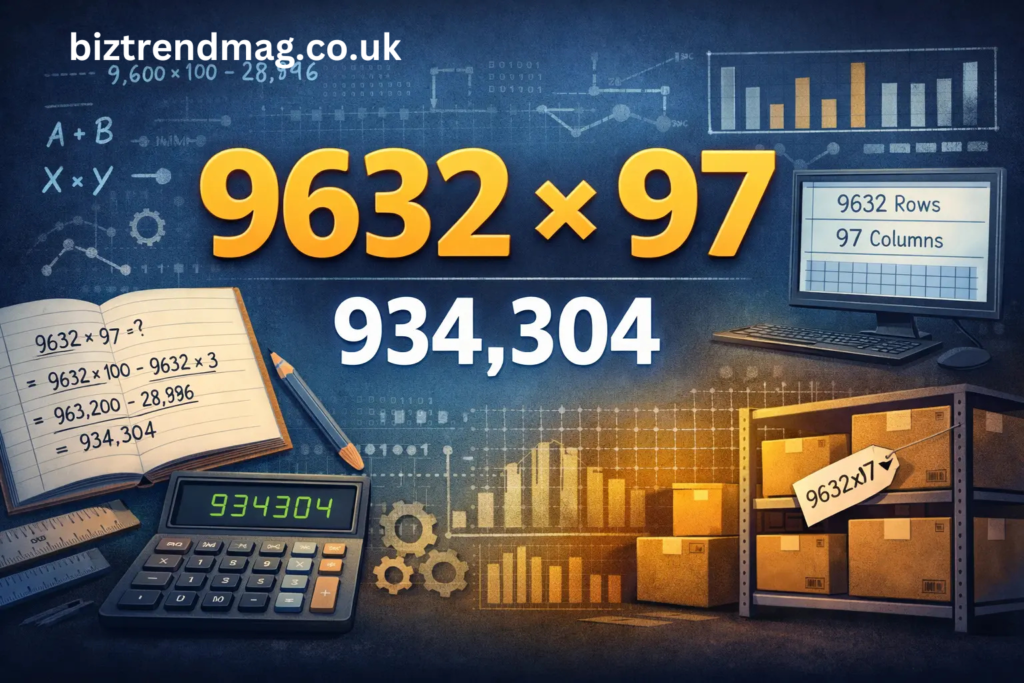
- Add the results: 866,880 + 67,424 = 934,304
Therefore, 9632×97 equals 934,304.
While this may seem like a straightforward arithmetic calculation, sequences like 9632×97 have broader implications beyond basic math.
Historical Context of Numerical Sequences
Numerical sequences have been integral to human civilization for centuries. Ancient civilizations used numbers for trade, measurement, and astronomy. Over time, structured sequences like 9632×97 became tools to represent complex concepts efficiently.
- In Accounting: Numbers were used to keep ledgers of goods and transactions.
- In Education: Sequences helped in teaching arithmetic and problem-solving skills.
- In Technology: Today, numbers often serve as identifiers in databases, software systems, and digital platforms.
By examining sequences like 9632×97, we can appreciate how historical practices in mathematics have shaped contemporary numerical usage.
Mathematical Insights from 9632×97
Understanding 9632×97 mathematically allows for exploration of larger principles in arithmetic and number theory. Breaking down the multiplication:
- Distributive Property: 9632 × 97 can be rewritten as (9632 × 100) – (9632 × 3), making calculation easier.
- Patterns in Numbers: Multiplying large numbers often reveals patterns useful in more advanced math topics like algebra and modular arithmetic.
- Applications in Problem-Solving: Large-number multiplication, like in 9632×97, teaches precision, systematic calculation, and attention to detail.
9632×97 in Education
Educators often use sequences like 9632×97 to demonstrate real-world math applications. For students:
- Step-by-Step Learning: Breaking down large multiplication problems improves computational skills.
- Understanding Place Value: Multiplying multi-digit numbers emphasizes the importance of units, tens, hundreds, and thousands.
- Practical Examples: Applying 9632×97 in scenarios such as inventory management or financial calculations makes math relevant.
For instance, if a factory produces 9632 units of a product, and each unit requires 97 components, students can calculate the total number of components by multiplying 9632 by 97. This reinforces both practical reasoning and arithmetic skill.
Technological Applications of 9632×97
In modern technology, number sequences like 9632×97 have significant uses:
1. Software Development
Developers often use unique numerical sequences to:
- Assign user IDs or system codes
- Track version numbers in software builds
- Generate keys for applications
The structured format of 9632×97 makes it suitable for avoiding duplicate identifiers and maintaining database integrity.
2. Data Analysis
Data analysts frequently work with structured numerical sequences:
- Dataset Organization: Numbers like 9632×97 can represent product counts, experimental results, or statistical values.
- Sorting and Filtering: Large sequences allow for efficient data management.
- Computational Operations: Multiplication of numbers in sequences can model real-world scenarios, such as calculating totals or scaling values.
3. Machine Learning and AI
In machine learning, structured numbers serve as:
- Feature values for models
- Encoded identifiers for datasets
- Numerical keys in hashing functions
Sequences such as 9632×97 illustrate how numerical inputs can drive algorithms and influence predictions.
Real-Life Examples of 9632×97
Practical examples help contextualize the importance of 9632×97:
- Inventory Management: A warehouse storing 9632 items, each needing 97 packaging units, can calculate total packaging using the sequence. Total = 9632 × 97 = 934,304 units.
- Financial Estimates: Businesses may calculate revenue projections using similar multiplication sequences. For instance, 9632 products sold at $97 each generate $934,304 in revenue.
- Engineering Calculations: Large-scale engineering projects use multiplication sequences to determine material requirements or total costs.
Symbolic Interpretations of 9632×97
Beyond mathematical calculations, sequences like 9632×97 can hold symbolic significance:
- 9632 could represent quantity, base values, or production units.
- 97 might symbolize a rate, coefficient, or scaling factor.
- Together represents the relationship between a base quantity and its multiplier, making it useful for modeling real-world phenomena.
Step-by-Step Techniques for Working with 9632×97
For beginners, breaking down large multiplication problems helps ensure accuracy:
- Separate the Numbers: 9632 × 97
- Split the Multiplier: 97 = 90 + 7
- Multiply in Parts:
- 9632 × 90 = 866,880
- 9632 × 7 = 67,424
- Add Results: 866,880 + 67,424 = 934,304
- Verify: Double-checking ensures precision
This method not only simplifies large multiplications but also builds confidence in handling bigger numbers.
Common Mistakes When Calculating 9632×97
Even experienced individuals can make errors when handling large numbers:
- Misalignment in Place Values: Forgetting to account for tens, hundreds, or thousands can result in incorrect sums.
- Skipping Verification: Not checking results can propagate errors in real-world applications.
- Overcomplicating the Problem: Breaking the problem into smaller parts is often the simplest and most effective approach.
Advanced Applications in Science and Finance
Sequences like have broader applications:
- Cryptography: Large numbers are integral to encryption algorithms.
- Scientific Simulations: Engineers use multiplication sequences to scale experiments and compute outcomes.
- Financial Modeling: Analysts use similar sequences to calculate compound totals, revenue, and profit forecasts.
Understanding these advanced applications shows the versatility of numerical sequences in various domains.
Fun Facts About Multiplication Sequences
- Multiplication patterns often reveal hidden relationships between numbers.
- Some sequences can result in palindromic products or repeating number patterns.
- Teaching multiplication through sequences like enhances both computational and analytical skills.
9632×97 in Problem-Solving Exercises
Practical exercises help solidify understanding:
- Scenario-Based Question: A bookstore stocks 9632 books, each sold at $97. Calculate the total revenue.
- Solution: Multiply 9632 × 97 = 934,304
- Insight: Applying sequences to real-world scenarios makes math meaningful.
Such exercises bridge the gap between theoretical math and practical application.
Why 9632×97 Matters Today
In a world increasingly driven by data, sequences like are more relevant than ever. They:
- Promote structured thinking
- Enhance computational skills
- Enable precise modeling in business, technology, and education
- Demonstrate the practical power of mathematics in everyday life
By studying individuals can gain both practical and analytical skills applicable across various fields.
Conclusion
The number sequence 9632×97 is more than just an arithmetic calculation. It represents the intersection of mathematics, technology, and real-world application. From education and data analysis to engineering and finance, understanding and applying sequences like can simplify complex tasks, enhance problem-solving skills, and provide valuable insights.
Whether you are a student learning multiplication, a professional analyzing data, or a developer managing digital systems exemplifies how numbers can carry meaning, structure, and purpose beyond their immediate value.
